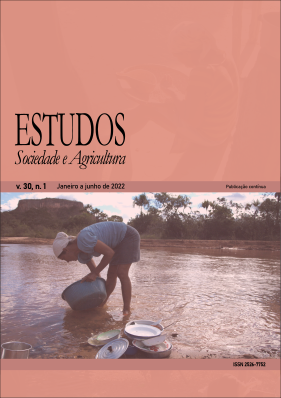
The multiplicity of water in people's actions: body, gender, and materialities in a quilombo in Pernambuco
DOI:
https://doi.org/10.36920/esa-v30-1_st02Keywords:
water, gender, corporalities, materialities, fieldworkAbstract
This article is based on an ethnography of quilombola families in the countryside of Pernambuco. As I became more solidly established in the daily life of this community, my position in terms of gender and generation allowed me to shift my focus to local forms of using, classifying, and symbolizing water. Perceiving the multiplicity of water (in terms of sensory characteristics, qualities, effects, and relationships with bodies and collectivities) permits critical reflection on academic and government discourses on the semiarid region, which consider water a scarce natural resource. By focusing on the daily dynamics of water, the home emerged as a center from which the handling of water revealed connections between bodies and materialities. These connections proved valuable for thinking about the uses of water in relation to gendered work and attributions, conflicts, expectations and moral judgments, situations of prestige and humiliation, forms of care, and public presentation of bodies.
elocation-id: e2230110
Recebido: 11.15.2021 • Aceito: 04.04.2022 • Publicado: 20.05.2022
Original article / Blind peer review / Open access
Downloads
Downloads
Published
Issue
Section
License
Copyright (c) 2022 Marcela Rabello de Castro Centelhas

This work is licensed under a Creative Commons Attribution 4.0 International License.
Authors who publish in this journal agree to the following terms:
a) Authors maintain the copyright and grant the journal the right of first publication, with the work simultaneously licensed under the Creative Commons Attribution License which allows the sharing of the work with acknowledgment of authorship and initial publication in this journal.
b) Authors are authorized to take additional contracts separately, for non-exclusive distribution of the version of the work published in this journal (eg publish in institutional repository or as a book chapter), with acknowledgment of authorship and initial publication in this journal.
c) Authors are allowed and encouraged to publish and distribute their work online (eg in institutional repositories or on their personal page) at any point before or during the editorial process, as this can generate productive changes, as well as increase the impact and citation of published work (See The Effect of Free Access).